The Physical AI Frontier: Closing the Gap Between Simulation and Reality
The Robotensor team8 min read
The next frontier of robotics AI is turning intelligence learned in simulation into reliable behavior in the physical world. Sim2Real is becoming a core stack—combining domain randomization, system identification, digital twins, learned dynamics, and real-world feedback to bridge that gap.
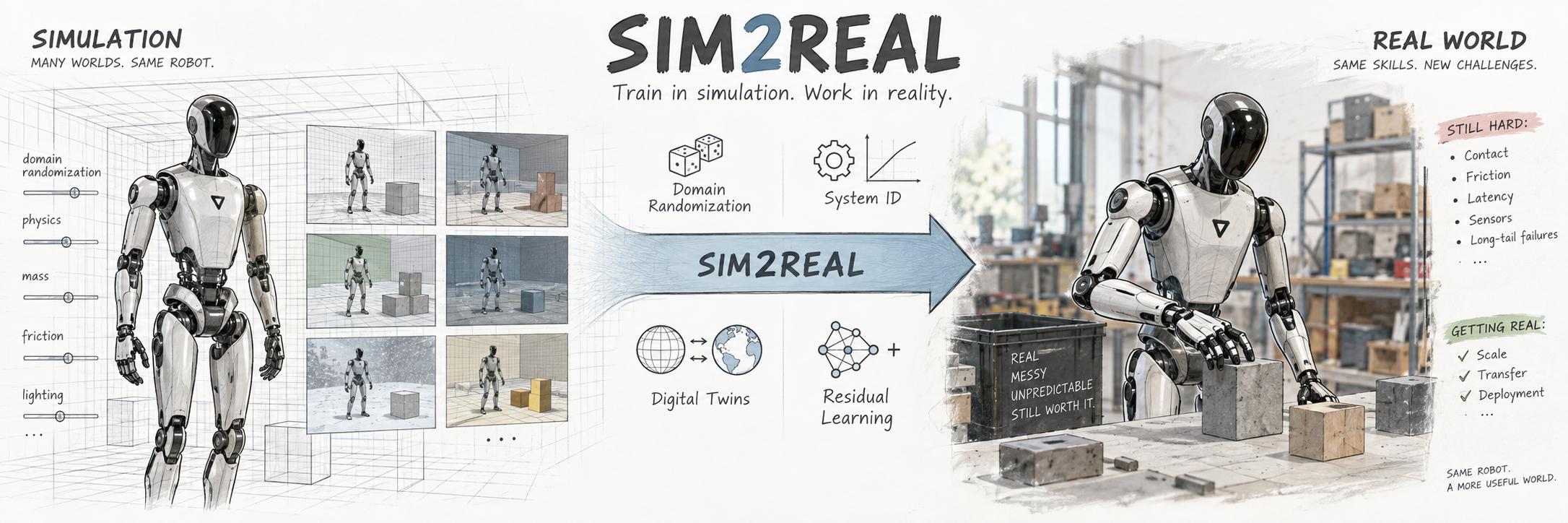
Robotics has a data problem.
Modern robot policies—RL policies, imitation-learning models, and increasingly Vision-Language-Action models—need enormous amounts of experience.
But collecting that experience on real robots is painfully expensive.
A physical robot cannot perform millions of experiments overnight. Every rollout consumes time. Robots break. Motors heat up. Batteries drain. Humans need to reset scenes. Dangerous failures have real consequences.
Simulation changes the economics completely.
Thousands of virtual robots can train in parallel. They can fall over, collide, retry, and explore unsafe behaviors without destroying hardware.
This is why simulation has become one of the foundations of modern robot learning. Frameworks such as @NVIDIARobotics's Isaac Lab and MuJoCo Playground—coauthored by @pabbeel—are explicitly designed around massively parallel robot learning and eventual sim-to-real deployment. (research.nvidia.com)
But there is one obvious problem:
the world inside the simulator is not the real world.
That difference is the Sim2Real gap, or more broadly, the reality gap.
What exactly is the Sim2Real gap?
It is tempting to think the problem is simply that simulated images don't look realistic enough.
That is only one part of it.
A robot can encounter gaps at almost every level of its system.
The simulated camera has different noise, exposure, reflections and motion blur.
The simulated floor has the wrong friction.
A simulated motor produces exactly the commanded torque, while the real motor has backlash, saturation, delays, temperature effects and manufacturing tolerances.
Contact between two rigid objects behaves slightly differently.
Cables, clothes, food, rubber and other deformable materials are dramatically harder.
Control packets arrive with latency.
Calibration is imperfect.
The physical environment contains objects and disturbances that were simply never modeled.
The recent 2026 Annual Review on the robotics reality gap therefore treats the problem much more broadly than visual realism: discrepancies can come from dynamics, sensing, actuation, control, environment and the overall system design. (annualreviews.org)
And small errors matter.
If a quadruped's foot contacts the ground a few milliseconds differently, it may still recover.
If a robot hand is inserting a connector with millimeter-level clearance, the same error can turn success into failure.
That is why Sim2Real progress is highly uneven.
Locomotion has become surprisingly transferable.
Precise, contact-rich manipulation remains much harder.
The first major solution: don't simulate one world
One of the most influential ideas in Sim2Real is domain randomization.
Instead of building one supposedly perfect simulation, train the robot in thousands of imperfect ones.
Change friction.
Change mass.
Change lighting.
Move the camera.
Perturb joint parameters.
Add sensor noise.
Change object positions and textures.
Apply random external forces.
The objective is simple:
Reality does not need to exactly match the simulator if reality falls somewhere inside the distribution the policy has already learned to survive.
This idea produced some of the earliest famous Sim2Real demonstrations.
@OpenAI's Dactyl trained a dexterous robotic hand entirely in simulation and transferred the policy to physical hardware without real-world fine-tuning. Later, Automatic Domain Randomization was used for the Rubik's Cube robot-hand system. (openai.com)
Domain randomization is still everywhere today.
But it has a fundamental weakness.
Randomize too little and reality lies outside the training distribution.
Randomize too much and the robot learns a conservative policy that performs reasonably everywhere but optimally nowhere.
Recent work increasingly treats domain randomization as a baseline rather than the final answer. Research on legged robots, for example, explicitly reports that poorly tuned DR can create overly conservative policies and instead combines transfer with more targeted system identification. (proceedings.mlr.press)
Trend #2: measure reality, then make simulation match it
This leads to another old idea that is becoming much more sophisticated:
System Identification.
Instead of guessing friction, actuator strength, damping, latency and other parameters, run the physical robot, observe what actually happens, and estimate simulator parameters that reproduce those trajectories.
Recent approaches can actively choose robot motions specifically because those motions reveal unknown physical parameters.
The philosophy is almost the opposite of pure domain randomization.
Domain randomization says:
"Make the policy survive many possible worlds."
System identification says:
"Find the world that most closely resembles this robot."
In practice, increasingly strong systems combine both.
Trend #3: Real → Sim → Real
Perhaps the most interesting shift is that Sim2Real is no longer necessarily a one-way pipeline.
Instead:
Reality → build simulation → train → return to reality.
@MIT_CSAIL's RialTo, developed by a team including @pulkitology, is a good example.
A real environment is scanned and converted into a digital twin. Real demonstrations are transferred into that simulation. Reinforcement learning then generates much more experience safely inside the digital environment before the resulting policy goes back onto the robot.
Across its manipulation experiments, RialTo reported more than a 67% improvement in robustness over imitation learning using the same amount of demonstration data. (arxiv.org)
3D reconstruction is making this increasingly practical.
NeRFs were one step.
Now 3D Gaussian Splatting is becoming especially interesting because real environments can be reconstructed quickly with extremely realistic appearance.
Recent systems such as SplatSim from @CMU_Robotics and newer Gaussian-Splatting digital twins combine photorealistic reconstruction with conventional physics geometry, trying to preserve both visual realism and physically meaningful collisions. (publications.ri.cmu.edu)
So instead of engineers manually recreating every deployment site inside a simulator, the real world itself increasingly becomes the source from which simulation is generated.
Trend #4: teach the simulator its own mistakes
There is an even more interesting approach:
don't just identify physical parameters.
Learn the residual difference between simulation and reality.
ASAP—a collaboration involving @CMU_Robotics and @NVIDIARobotics researchers including @GuanyaShi and @DrJimFan—demonstrated this idea for agile humanoid control.
The system first trained humanoid motions in simulation.
Then the real @UnitreeRobotics G1 executed those policies.
The resulting real-world trajectories revealed where simulated dynamics were wrong.
A learned residual model captured that mismatch, was inserted back into simulation, and the policy was trained again.
Instead of hoping that the simulator is correct, the system effectively learns:
simulation + learned error ≈ reality.
ASAP showed improved transfer of highly dynamic whole-body humanoid motions compared with conventional system identification and domain-randomization approaches. (arxiv.org)
This is part of a broader trend toward learned physics and neural dynamics models.
@NVIDIARobotics's NeRD work follows a similar direction: analytical simulation remains useful, but neural models can learn dynamics that classical equations or contact solvers systematically miss. (developer.nvidia.com)
Trend #5: simulators themselves are changing
For years, simulation involved a fundamental trade-off:
speed vs. fidelity.
A highly accurate simulation was expensive.
A massively parallel simulation had to simplify reality.
GPU-native robotics simulators are weakening that trade-off.
@NVIDIARobotics's Isaac Lab runs large numbers of parallel simulations while combining physics, sensors, rendering and domain randomization.
MuJoCo Playground, whose contributors include @pabbeel, is designed specifically to make GPU robot learning and zero-shot Sim2Real easier.
Newton goes further toward differentiable, multi-physics simulation: contacts, deformable bodies, granular materials and other phenomena can increasingly be modeled while retaining GPU acceleration. (research.nvidia.com)
And differentiable physics introduces another possibility:
instead of manually tuning simulator parameters, gradients can help optimize them against real observations.
Simulation itself is becoming trainable.
Trend #6: simulation is becoming a data factory
Sim2Real used to mostly mean:
train an RL policy in simulation → deploy it on the robot.
That definition is becoming too narrow.
Simulation is increasingly used to generate training data for large robot models.
@NVIDIARobotics's GR00T work, for example, mixes real robot demonstrations, internet-scale video and synthetic trajectories. NVIDIA reported generating 780,000 synthetic manipulation trajectories—equivalent to roughly 6,500 hours of demonstrations—in 11 hours with its synthetic-data pipeline. (research.nvidia.com)
World models push this further.
Instead of requiring engineers to manually construct every variation of a simulated scene, generative models can produce new environments, appearances and candidate robot trajectories.
Frameworks such as GenSim2—even spanning researchers from Tsinghua, UCSD, Shanghai Jiao Tong and @MIT_CSAIL—are using multimodal and reasoning models to automatically create simulation tasks and scenes. (proceedings.mlr.press)
The emerging picture is:
Real data provides grounding. Simulation provides scale. Generative models provide diversity.
And Sim2Real is already achieving remarkable things
The field has moved far beyond toy demonstrations.
@OpenAI demonstrated simulation-trained dexterous manipulation.
@GoogleDeepMind's DemoStart transferred difficult hand skills from MuJoCo to physical hardware and reported a 97% success rate on cube reorientation/lifting and 64% on a precise plug-insertion task. (deepmind.google)
Humanoid-Gym demonstrated zero-shot transfer of learned locomotion to real XBot humanoids and even introduced sim-to-sim testing—testing a policy across different physics engines before risking real hardware. (arxiv.org)
ASAP from the @CMU_Robotics/@NVIDIARobotics team demonstrated much more agile humanoid motions by learning the residual physics mismatch on the @UnitreeRobotics G1.
@MIT_CSAIL's RialTo showed how real environments themselves can become simulation environments.
Sim2Real is no longer evidence that simulation might work.
It clearly works.
The question now is where it works reliably enough to become engineering infrastructure rather than a research demonstration.
What still isn't solved?
The hardest remaining problem is physics that becomes extremely sensitive around contact.
Friction isn't one constant.
Materials deform.
Grippers flex.
Surfaces wear.
Gearboxes have backlash.
Motors heat up.
Cables bend.
Fabric folds.
Objects collide at tiny contact patches.
Even increasingly advanced simulators cannot reproduce all of this perfectly.
Then there is the temporal gap.
Real systems have communication latency, asynchronous sensors, dropped frames, actuator delays and control-stack jitter.
There is also the long-tail problem.
Domain randomization can only randomize variables engineers—or generative systems—know should vary.
Reality is extremely good at producing situations nobody thought to simulate.
And finally there is an evaluation problem.
A policy achieving 99% success in simulation does not automatically imply anything close to 99% success in reality.
The relationship itself must be validated.
The newest literature therefore increasingly treats the reality gap not as something that can be permanently "closed," but as something that must be continuously measured, reduced and managed. (annualreviews.org)
The direction Sim2Real is heading
The old pipeline was:
Simulation → Robot
The emerging pipeline looks more like:
Real world → Digital twin → Massive simulation → Robot → Measure failures → Update simulation → Retrain → Robot
Simulation gives robotics something the physical world cannot provide cheaply:
scale.
Reality provides something simulation cannot manufacture perfectly:
ground truth.
The future probably isn't robots trained entirely in simulation.
And it isn't robots trained entirely in reality.
It is a continuous sim-real data flywheel, where each side fixes the weaknesses of the other.
That's why the Sim2Real gap remains one of the most important problems in robotics.
Paradoxically, robotics may scale not when simulation finally becomes indistinguishable from reality—
but when robots become good enough at learning from the difference.
Categories: #Robotics #Sim2Real #RobotLearning #EmbodiedAI #PhysicalAI #HumanoidRobotics #Simulation