Where Robots Will Win
Robots will reach factories and homes at different speeds, and the winners won’t be picked by body shape but by reliability, changeover cost and net time saved, which is why Robotensor is building the intelligence layer for robots through open, decentralized competition on Attune (SN58), where models that learn new tasks from a single demonstration are tested head to head with every result public.
The next wave of robotics will reach factories and homes at different speeds. Its commercial progress will depend on how much useful work a machine can perform—and how much effort people spend keeping it working.
Jensen Huang described robotics as the next $10 trillion industry at GTC 2025. @NVIDIA’s investment in robot models, simulation, and computing reflects that ambition. Turning such a forecast into revenue, however, requires thousands of individual tasks to become economical to automate.
That process will favor different bodies for different jobs.
A robot arm is well suited to work within a defined space. A humanoid offers mobility and access to environments designed for people. Neither shape determines how intelligent the machine is, and neither guarantees a viable business.
That intelligence is its own layer, and it's the one we're building at Robotensor (@robotensor_ai): the intelligence layer for robots. The goal is models that let a machine adapt to new work instead of being reprogrammed for it, whichever body it ships in.
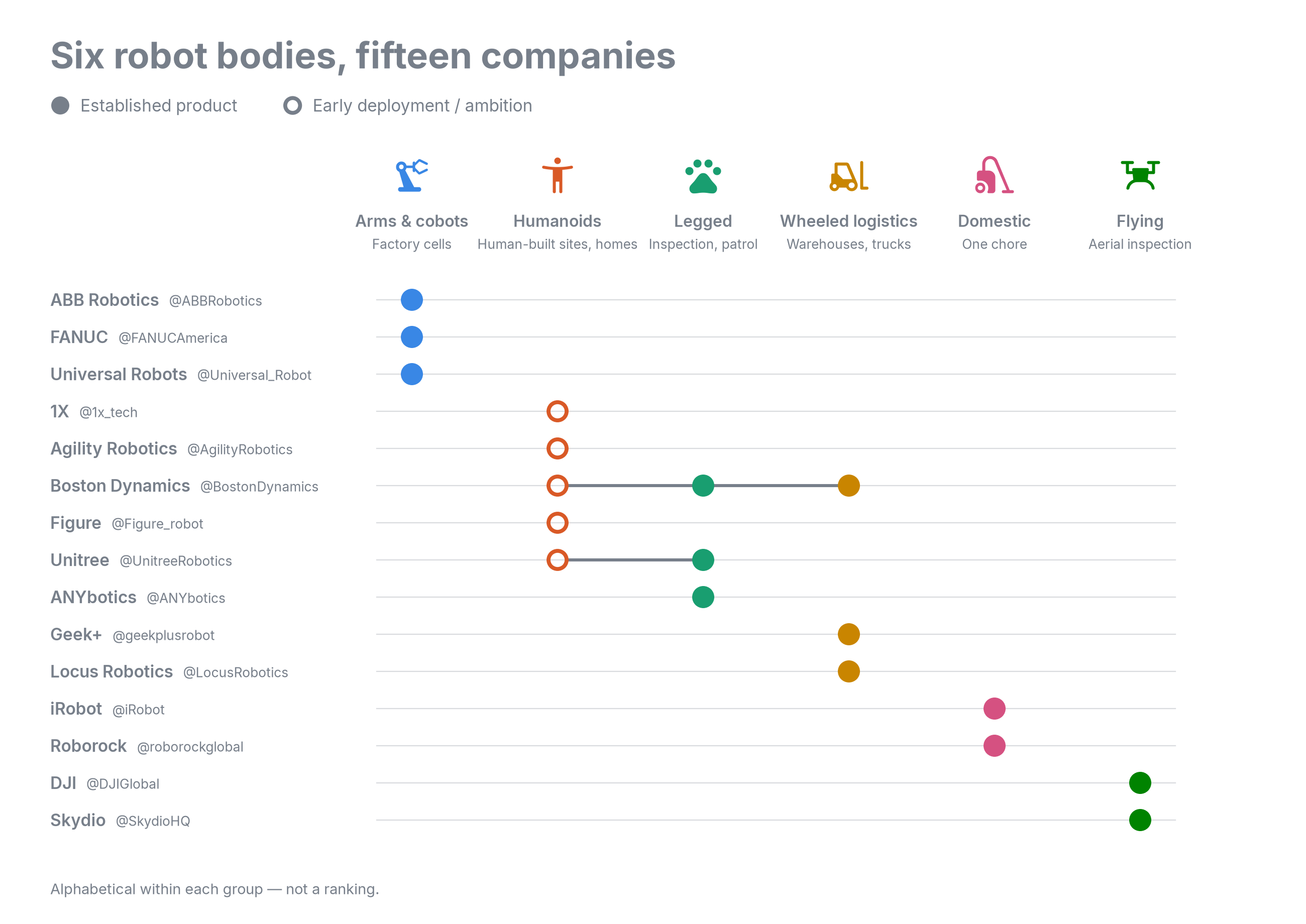
The companies pursuing these markets reflect that distinction. FANUC and Universal Robots sell manipulation equipment for production tasks. ANYbotics concentrates on industrial inspection. Geek+ automates warehouse movement. Among humanoid developers, Agility emphasizes industrial material handling, while 1X explicitly targets homes. These companies face different customer requirements even when they share underlying technologies.
The strongest starting point is a task that repeats enough to repay the investment.
Factories offer a clear advantage here. A machine may need loading hundreds of times per shift. Each successful cycle has measurable value, and the same installation can accumulate productive hours day after day.
According to @IFR_Robots, more than 600,000 industrial robots were installed in 2025, bringing the operating fleet to roughly 5 million. That installed base establishes both demand and a demanding competitive standard: new robots must improve on equipment that customers already know how to purchase, operate, and maintain.
The market extends beyond factories. @IFR_Robots also reported approximately 250,000 professional service robots sold in 2025, including 117,500 transport and logistics robots, and 34.2 million consumer service robots. Annual growth was 11% for industrial installations, 24% for professional service robot sales, and 37% for consumer service robot sales. These are different reporting categories, not directly comparable revenue markets.
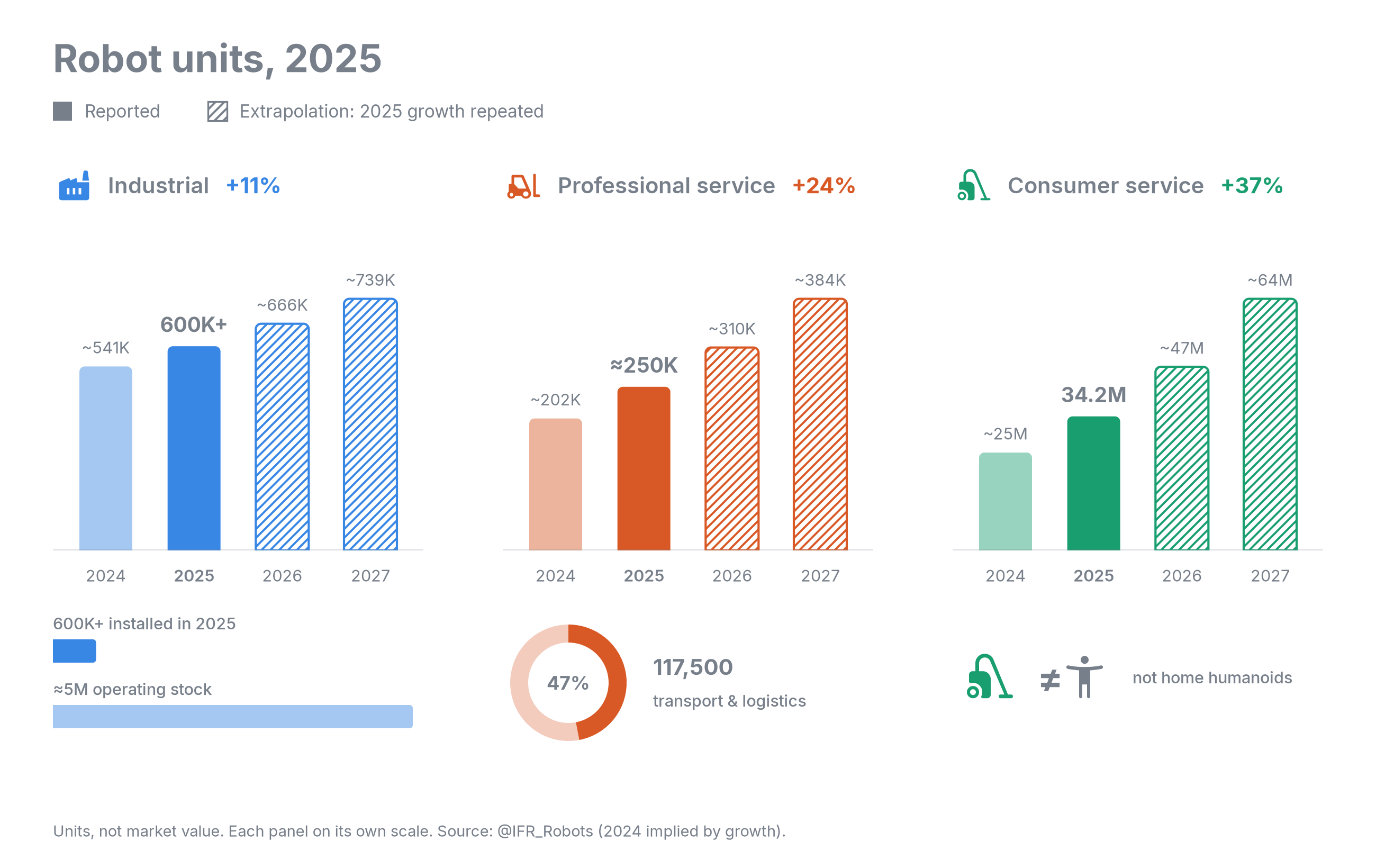
These figures show that customers already buy robots in large numbers for specific jobs. The opportunity for more general machines is to extend that useful work while remaining competitive on cost and reliability.
For repetitive work within a fixed reach, an arm has a straightforward advantage. It does not need to move its entire body to load a machine or transfer a part. Its hardware can concentrate on the required payload, speed, and precision.
But the arm’s purchase price is only part of the bill. Fixtures, grippers, cameras, programming, and changes to the production line can determine whether automation pays off.
This creates an opening for more flexible machines. A more expensive robot can still be the cheaper solution if it substantially reduces installation work or can serve several tasks without extensive rebuilding.
This is the problem Robotensor is built around. If a robot can learn a new task from a single demonstration, a changeover stops being a reprogramming project. The goal is changeovers measured in hours, not months. For integrators, task changes stop being unpaid rework that eats margin. For plant managers, the line keeps running when the work changes.
Humanoids must turn flexibility into measurable savings.
The strongest commercial argument for a humanoid is compatibility with existing workplaces. Workstations, shelves, tools, and access routes were often designed around human reach and movement.
A humanoid could work across those locations while requiring fewer changes to the environment. The economic question is whether those savings exceed the cost of maintaining and controlling a more complex machine.
Mobility alone does not settle that question. On a flat factory floor, a wheeled base carrying one or two arms is also a serious option. Legs become valuable when the work actually benefits from stepping, negotiating obstacles, or changing body position in ways a simpler platform cannot accommodate.
Production deployments are beginning to make these comparisons possible.
@Figure_robot reported that Figure 02 loaded more than 90,000 parts over 1,250-plus operating hours at BMW’s Spartanburg plant. The humanoid loaded sheet metal into fixtures; conventional industrial robots performed the welding afterward.
That division of work suggests a plausible future: different robot types operating together, each assigned the tasks that justify its design.
The same @Figure_robot report specified an 84-second cycle requirement, a target above 99% placement success per shift, and a goal of zero human interventions per shift. The success and intervention figures were targets, not published proof that both were consistently achieved.
These are the right kinds of measurements. They connect physical capability to production requirements.
Reliability changes the economics faster than a demonstration reveals.
Consider a hypothetical system attempting 1,000 tasks a day. At 99% success, it produces an average of ten unsuccessful attempts. Raising success to 99.9% reduces that average to one; 99.99% reduces it to one every ten days.
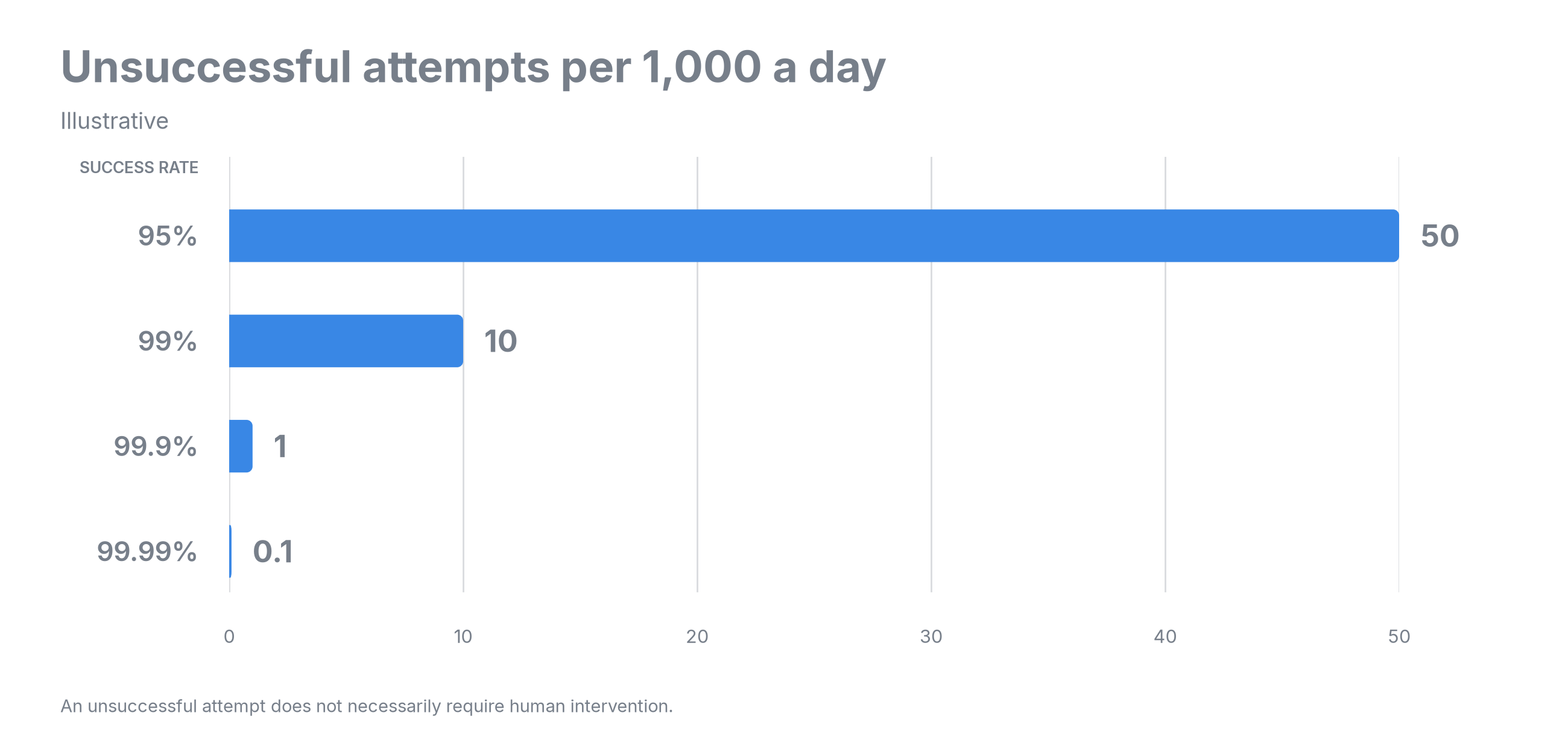
Ten automatic retries may be acceptable. Ten incidents requiring a technician may erase the labor savings. Ten damaged components may make the system unusable.
A useful commercial comparison therefore needs several measures together:
- Cost per acceptable completed task, including integration, maintenance, supervision, and rework.
- Productive hours per day, after charging, downtime, and setup.
- Interventions per 1,000 cycles, alongside the time required to resolve them.
- Changeover hours, when a new part or task is introduced.
- Payback period, calculated from demonstrated net savings.
Flexibility earns its premium when it improves these numbers. A factory running the same stable process for years may gain little from a machine capable of learning dozens of unrelated tasks.
These numbers also have to be earned in public. That's the idea behind Attune, Robotensor's subnet on Bittensor (SN58). Developers anywhere train robot models and submit them. Validators run them head to head on identical tasks in simulation, and every result, win or loss, is published.
Attune's first benchmark, Vector, tests in-context learning: a model watches one demonstration of a two-armed manipulation task, then has to perform it in a scene it hasn't seen. In Vector Level 2, the top model scored 91.3%, up from 87.9% in Level 1, on a harder task set. Level 3 is live now.
Those are simulation scores, not factory uptime. But they're public, reproducible and climbing, which is more than most robot demos can say.
Homes offer enormous demand, but a harder deployment model.
The consumer sales figures above demonstrate demand for domestic robotics. They do not establish equivalent demand for a general-purpose assistant at a much higher price.
The commercial strength of a dedicated cleaning robot is easy to understand: the buyer knows the job it is supposed to do.
A general household robot faces a much wider assignment. It must handle different objects, layouts, preferences, and interruptions, often without a trained person available to troubleshoot it.
Its utilization is also uncertain. A factory can schedule repeated work for an entire shift. A household assistant may perform several short chores separated by long idle periods. Broader capability could improve utilization, but only if those additional chores work reliably.
Part of what holds household robots back is data. Homes vary too much for any single lab to cover. Attune's second track, Horizon, turns smartphones into data-collection tools: contributors either control a simulated robot arm through kitchen tasks, like opening a fridge or washing fruit, or record their own everyday activity. Contributors earn performance-based rewards, and robots get to learn from how people actually do the work.
Coverage of Physical Intelligence’s π0 in Andrew Ng’s @DeepLearningAI captured this distinction: useful household demonstrations showed progress, while broad household readiness remained a separate question.
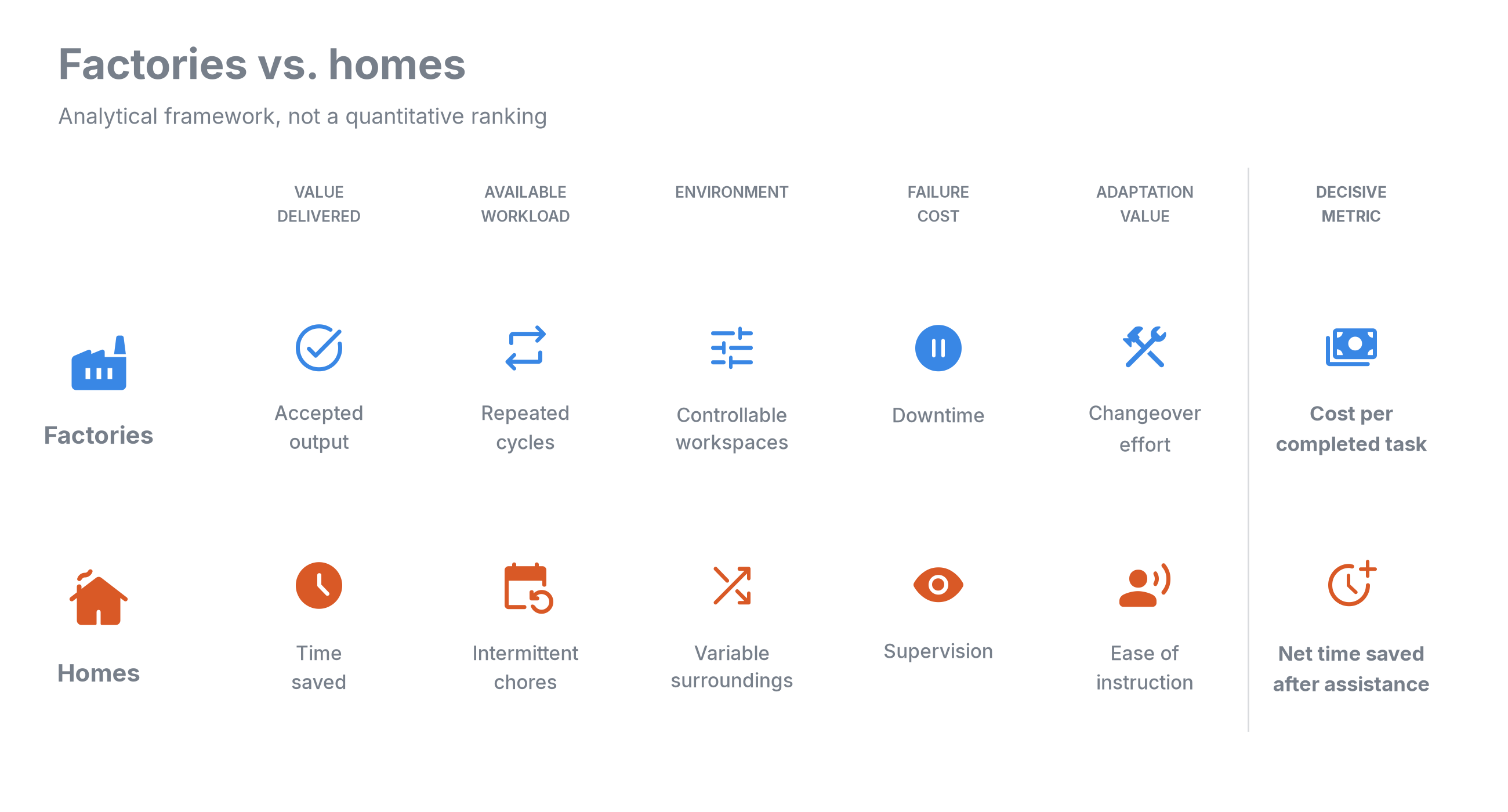
For consumers, the decisive metric is net time saved: time spent on chores minus time spent preparing, supervising, correcting, and maintaining the robot.
A machine that requires its owner to remain nearby has a much narrower value proposition than one that finishes while the owner does something else.
Factories and homes therefore place different demands on the same underlying technology. Industrial flexibility matters when it reduces setup and changeover costs. Household flexibility matters when it reduces how often the owner must explain, prepare, or rescue a task.
The likely path is gradual expansion from dependable tasks.
Over the next two to three years, the strongest commercial opportunities are likely to remain concentrated in work with clear boundaries, frequent repetition, and measurable outcomes. Arms and wheeled systems have a strong position there. Humanoids can expand where their reach and mobility reduce the need to redesign the workplace.
At home, dependable individual chores offer a clearer path to adoption than a promise to handle everything. Wider capability becomes commercially valuable as the need for assistance falls.
Longer term, a common robot platform that can learn many jobs could spread hardware, training, and servicing costs across a much larger market. That is a credible reason to invest in general-purpose robotics. It remains conditional on reliable execution and affordable deployment.
Why we're building it in the open.
That condition is why Robotensor builds through open competition instead of behind closed doors. On Attune, decentralized training means no single lab decides which approach wins. There's no application and no gatekeeper. Anyone with a model can compete, winning models earn rewards on Bittensor, and the strongest results feed back into the foundation models Robotensor is building.
Robot bodies will keep diversifying: arms, wheels, legs, humanoids. The intelligence layer is what has to carry across all of them, and we think the fastest way to build it is to let the world compete on it.
The milestone to watch is repeat purchasing: customers expanding beyond an initial installation because the machine delivers enough value to justify more units.
That is where technical progress becomes a durable robotics market.
You can try the models yourself at playground.robotensor.ai, or compete on Attune at attune.robotensor.ai.
Which robot job do you think gets automated first?
Links
Attune and Robotensor
Robotensor website
Attune (Subnet 58)
Docs
Whitepaper (PDF)
SN58 on Taostats
Build and mine
GitHub (Robotensor)
GitHub (Attune subnet repo)
Hugging Face
Community
X: @robotensor_ai
Discord (Robotensor)
Discord (SN58 channel)
YouTube
LinkedIn
Contact
Book a call
[email protected]
#Robotics #HumanoidRobots #IndustrialAutomation #HomeRobotics #PhysicalAI #Bittensor #SN58