Which Robot Policies will Win?
Programmed, modular, or end-to-end learned: which robot policies will win in industry? Each fits a different kind of task, and none wins everywhere. We argue the strongest near-term direction is an adaptive coordinator that combines general learned skills with conventional planners, judged by deployment efficiency. pickGPT is Robotensor’s first step toward it.
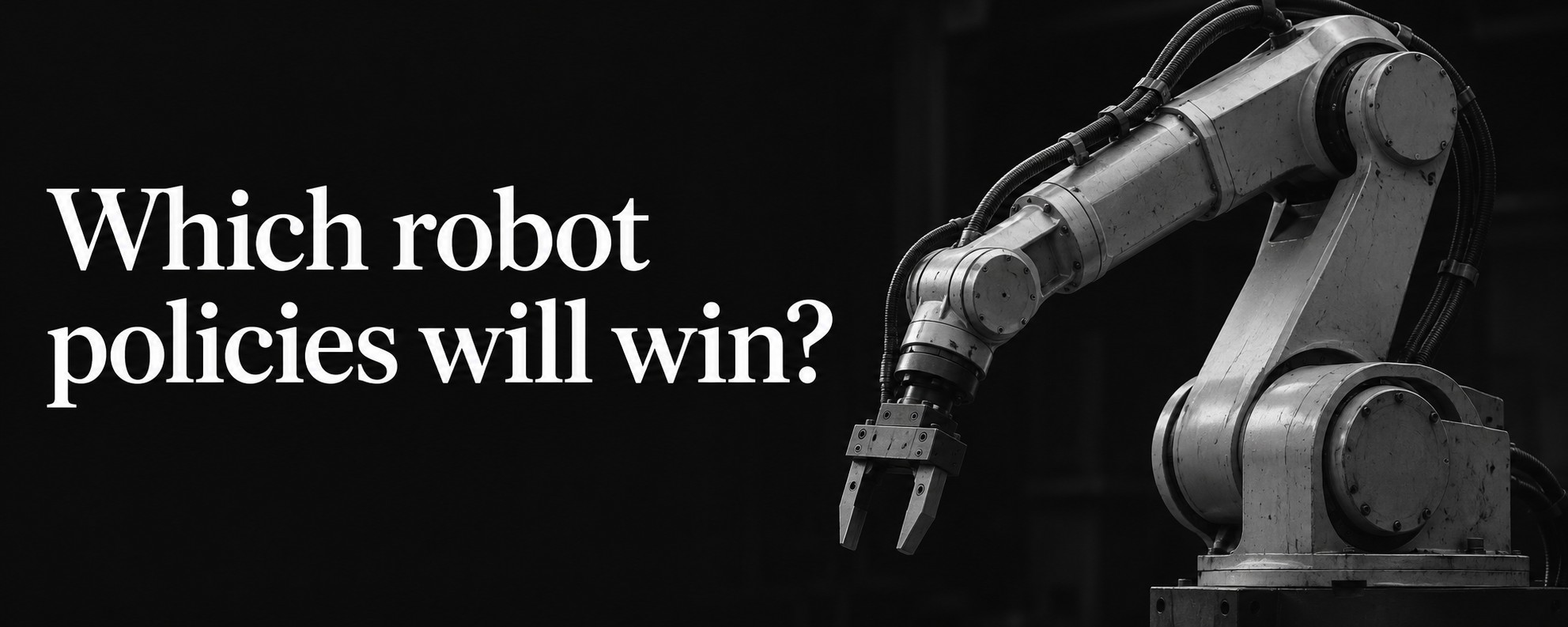
Industrial robotics has three broad approaches to control: programmed automation, modular automation, and end-to-end learned policies.
Each addresses a different source of difficulty. Their commercial prospects depend on whether the task requires repeatability, adaptation to changing geometry, or behavior that is difficult to specify explicitly.
Programmed automation: valuable where change is limited
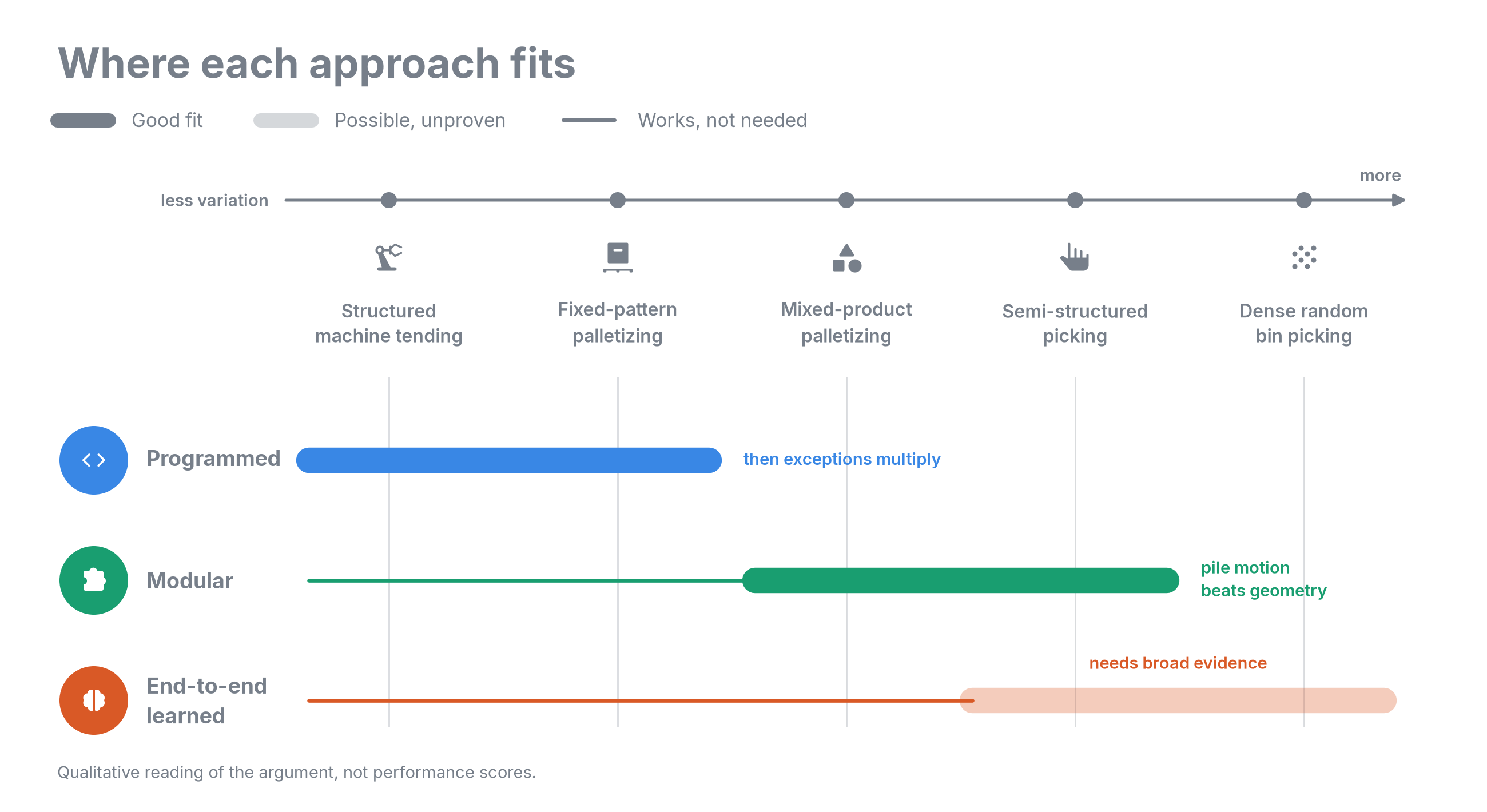
Programmed automation remains effective for repeatable welding paths, structured machine tending, and fixed-pattern palletizing. Its strengths are predictable execution, low computational overhead, and straightforward validation.
@Universal_Robot’s palletizing software, for example, provides templates for repeating operations across layers and patterns. Such applications do not inherently need a general-purpose model.
Its weakness appears when variation creates too many exceptions. Each new part, presentation, or failure condition can require additional programming and testing.
Programmed automation is therefore losing suitability as variability increases. Calling it obsolete would overlook the substantial amount of industrial work that remains deliberately repeatable.
Modular automation: a strong fit for industrial variability
Modular systems divide a task into perception, grasp selection, motion planning, and control. They can respond to changing object positions without relearning the entire job.
This makes them well suited to machine tending with variable pickup positions, semi-structured bin picking, and palletizing that requires geometric planning.
Their strength is specialization. A pose estimator solves localization; a planner handles reachability and obstacles; a controller tracks the movement. Each component can be optimized, tested, or replaced separately.
@NVIDIA’s cuRobo illustrates this approach through GPU-accelerated inverse kinematics, collision checking, and motion generation. Efficient specialized components can support fast execution without asking a large general model to solve every step.
The weakness is the boundary between components.
A pose estimate can be slightly wrong. A selected grasp can be reachable but unstable. A collision-free plan can still fail when an object slips or catches on its neighbours. Improving one module does not necessarily fix the complete behavior.
Dense bin picking exposes these limitations. Geometry alone cannot fully determine how a pile will move during finger insertion and extraction. Explicit recovery rules also become difficult to maintain as failure modes multiply.
The development opportunity is to make individual skills more general and responsive while preserving the visibility and control that modular systems provide.
End-to-end policies: broader capability, a difficult scaling problem
End-to-end policies can learn relationships between observations and actions that are awkward to express through separate rules. Their appeal is strongest for deformable objects, contact-rich manipulation, and recovery behaviors.
VLAs add the ability to connect instructions and visual understanding with physical actions. @GoogleDeepMind’s RT-2 work demonstrated how knowledge from vision-language training could contribute to robot behavior. This is a meaningful advantage when tasks require semantic understanding.
The commercial ambition is substantial: reuse knowledge across tasks and reduce the engineering required for each deployment.
But broader capability requires broader evidence. Success on several demonstrations does not establish dependable performance across unfamiliar factories, objects, grippers, and operating conditions.
The data problem creates a reinforcing constraint. Better policies could make robots easier to deploy widely; widespread deployment could provide the varied experience needed to improve those policies.
Collecting that experience before robots are dependable is expensive. Google’s RT-1 research explicitly identified robot data collection as an engineering-heavy process requiring autonomous operation or human demonstrations.
This is a chicken-and-egg problem, but not an absolute deadlock. Teleoperation, simulation, shared datasets, and narrowly scoped deployments can start the process. The unresolved commercial question is how cheaply they produce reliable capability on the next customer’s task.
Language specifies intent better than execution detail
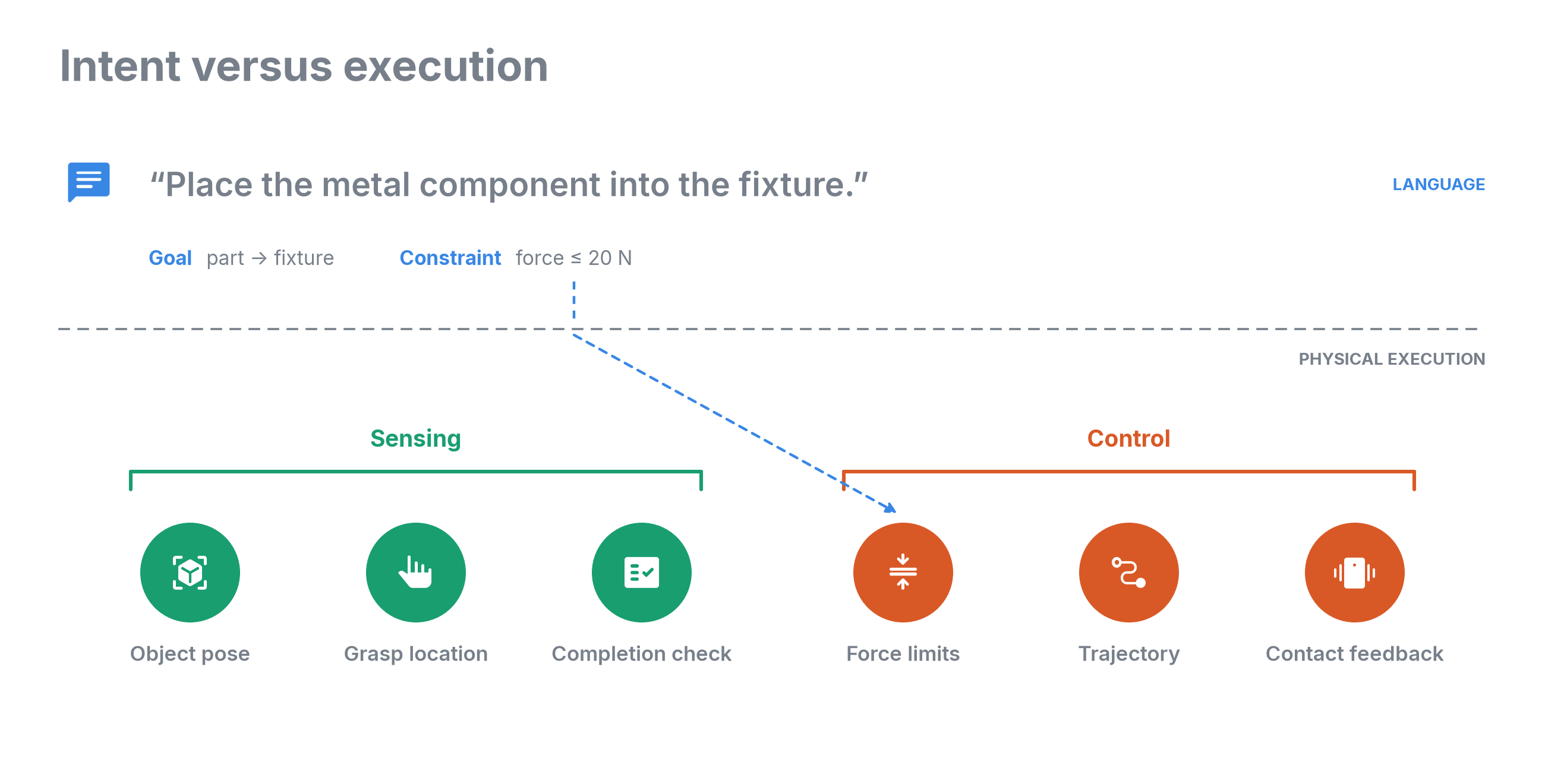
“Pick up the component and place it in the fixture” leaves many decisions unresolved: contact location, finger clearance, grip force, approach angle, and how to respond when insertion meets resistance.
Knitting, painting, and welding require even richer execution detail. Language can specify numerical parameters, but a verbal instruction alone does not provide the continuous physical feedback needed to execute them.
That does not make VLAs incapable of precision. They also use visual observations, robot state, and learned action patterns; language is only part of the input.
The narrower commercial point is that language understanding is often not the main industrial bottleneck. A production system may already receive an exact task identifier and recipe. Its difficulty is executing reliably despite physical variation.
For those applications, adaptability, contact handling, and recovery can be valuable even without a conversational interface.
The stronger commercial direction: an adaptive coordinator with general skills
A promising architecture combines modular structure with broadly trained neural skills.
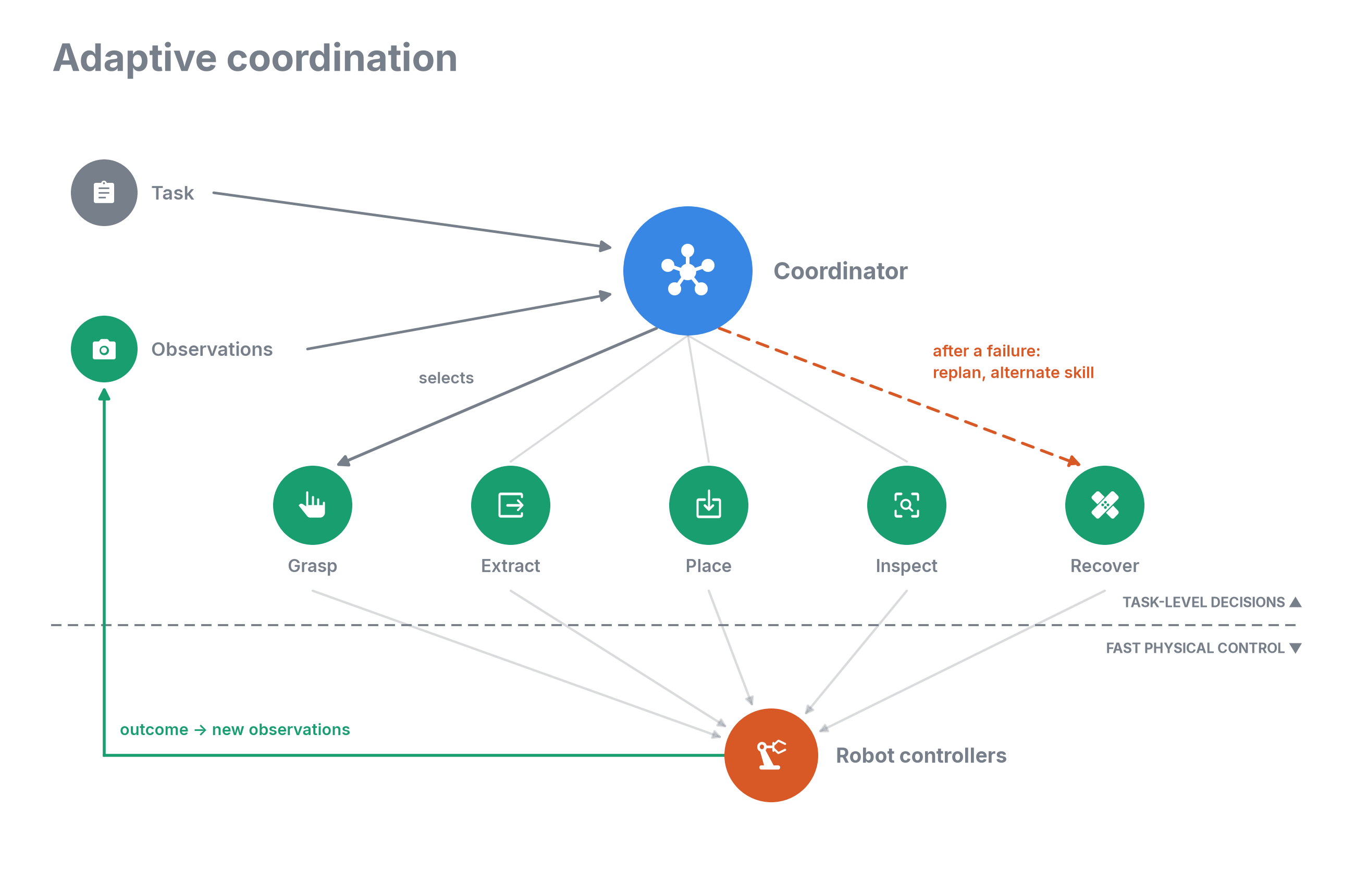
A coordinator observes the task and current state, selects a skill, checks the result, and changes strategy when necessary. It could use a decision model or an LLM supported by perception and explicit state.
The skills handle physical behavior: grasping, extracting, inserting, reorienting, or recovering. Each learned skill should generalize across variations within its scope. Conventional planners and controllers remain useful where they already perform well.
This is more flexible than a fixed workflow. If a grasp fails, the coordinator might request another view, select a different grasp, reposition an obstruction, or escalate the exception.
The coordinator should operate at the level of meaningful decisions. Fast motion and force feedback belong in the execution layer, where latency and precise control matter.
There is research support for this direction. @GoogleDeepMind’s Gemini Robotics-ER can coordinate robot APIs, specialized grasping models, and VLAs. @NVIDIA’s ASPIRE develops reusable robot skills through iterative execution and refinement, although its skills are programs rather than a library consisting entirely of neural policies. Neither establishes that the proposed architecture is universally superior, but both support adaptive coordination as a serious direction.
The near-term contest is deployment efficiency
Programmed systems retain an advantage where the task is stable. Modular systems remain a strong choice where geometry and explicit planning resolve most variation. Broad end-to-end policies offer greater potential as tasks become harder to specify and knowledge can transfer between deployments.
Selected learned applications can commercialize now. Broad replacement of industrial control systems is a much larger claim, requiring evidence on reliability, latency, recovery, and support cost.
Adaptive coordination offers a plausible way forward: deploy useful skills individually, gather experience from bounded applications, and expand capability without requiring one model to master every task before delivering value.
Its advantage should be judged by fewer commissioning hours, fewer interventions, higher acceptable throughput, and less data needed for the next task.
Putting this direction into practice
Robotensor is focusing on industrial robot policies, with bin picking, mixed-SKU palletizing, assembly, and welding as target applications. The technical direction combines generalization, in-context imitation learning, and online reinforcement learning: reuse capabilities across tasks, adapt from demonstrations, and improve execution through feedback.
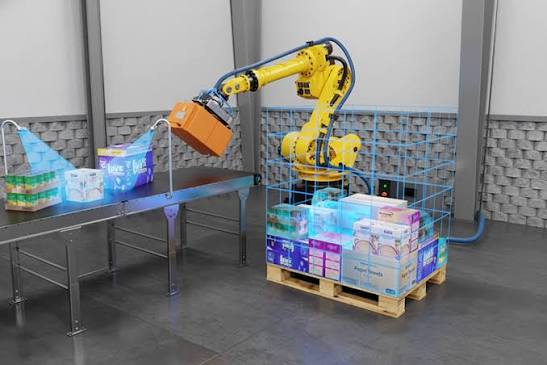
Bin picking and mixed-SKU palletizing emphasize generalization and adaptability. A picking policy must handle different shapes, grasp opportunities, and changing clutter. Palletizing adds placement decisions involving package dimensions, orientation, and stack stability. Learned skills can handle variation in manipulation, while geometric planning and explicit constraints govern reachability, collisions, and valid placements.
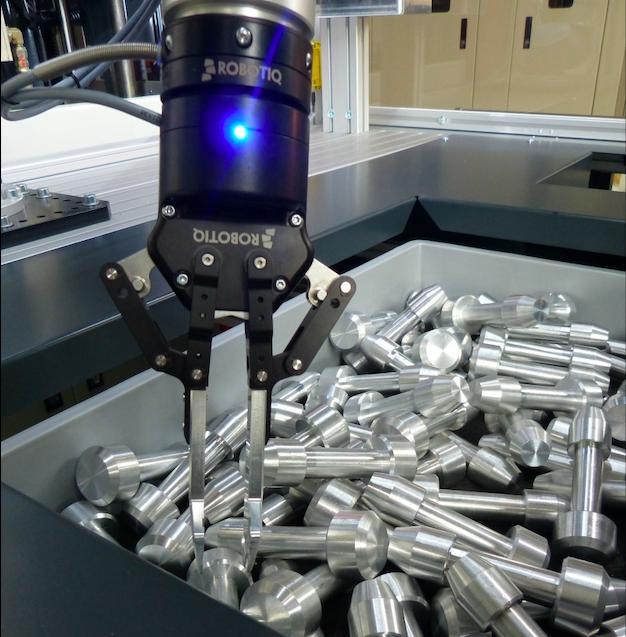
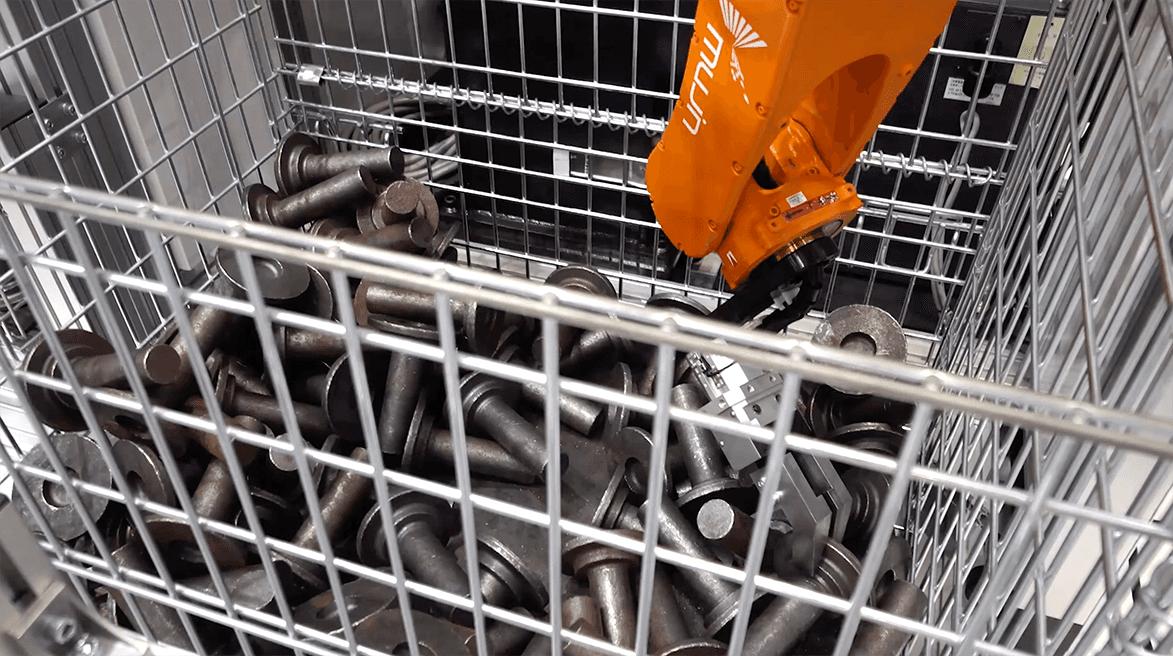
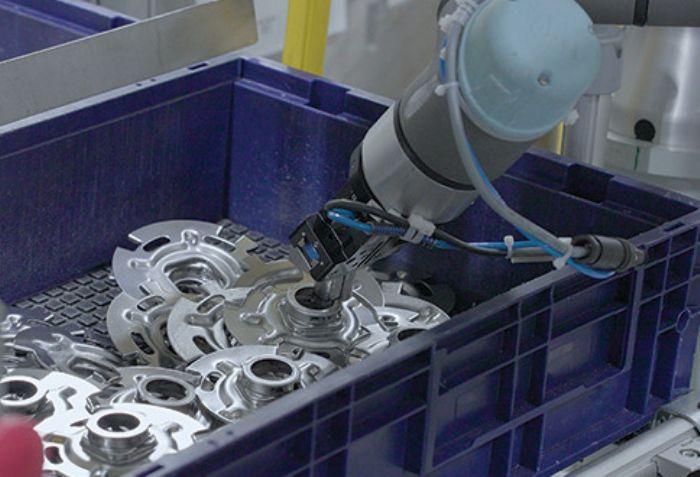
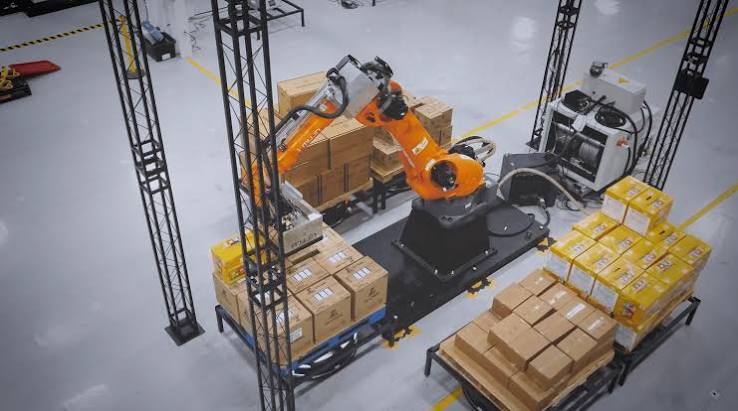
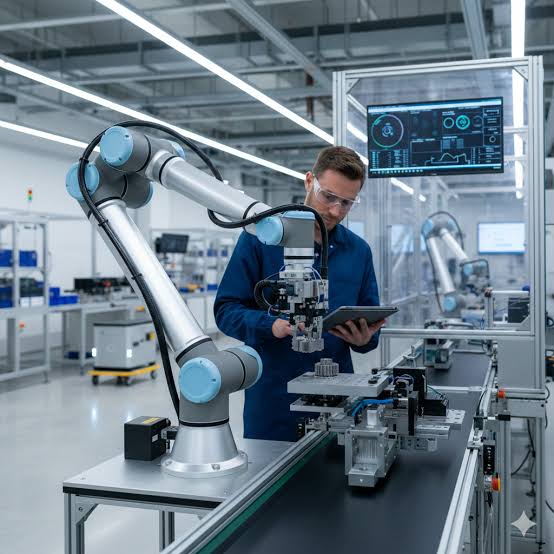
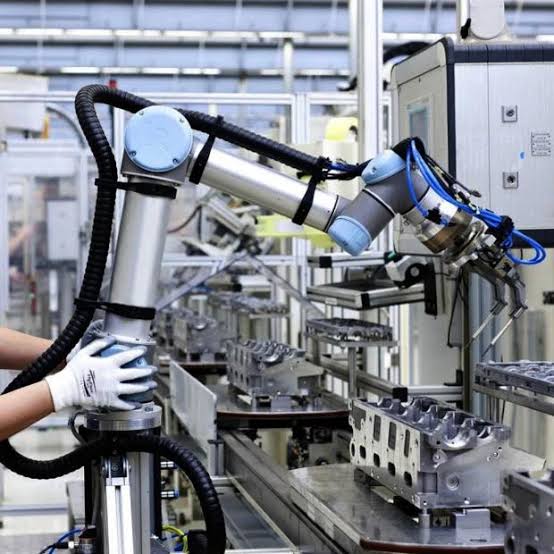
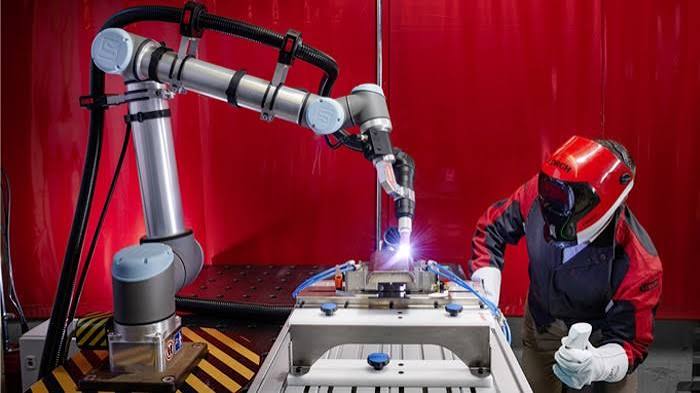
Assembly and welding make demonstration-based adaptation especially valuable. In-context imitation learning aims to let a policy use demonstrations of a new operation without retraining its weights for every change. For assembly, demonstrations can convey alignment, insertion, and contact sequences; for welding, they can convey the intended path and tool orientation. Demonstrations alone do not establish process quality: force feedback, dimensional tolerances, and validated welding parameters still matter.
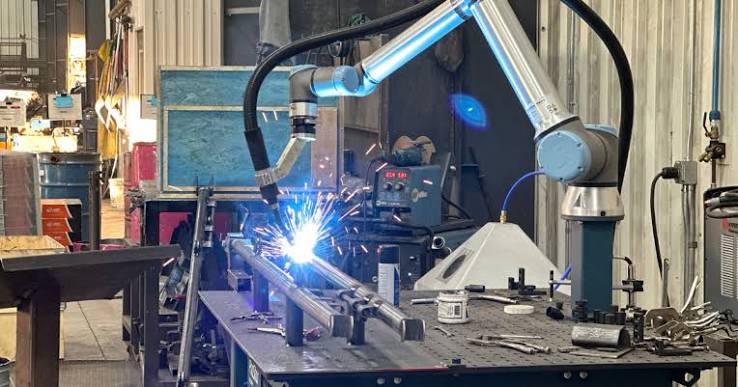
Online reinforcement learning is intended to improve these skills through execution feedback. Relevant outcomes include stable grasps, successful insertions, cycle time, and measured weld quality. Improvement would begin in simulation and proceed through controlled physical trials, with policy updates tested before production use. Production-level reliability is a measured requirement, not an automatic consequence of applying RL.
An adaptive coordinator would bring these capabilities together: select a skill, supply task context or demonstrations, monitor execution, and choose a recovery action when needed. Conventional planners and controllers would remain where they provide predictable motion and precise control. pickGPT is the first step toward this architecture, starting with a picking skill whose generalization, adaptation, and improvement can be evaluated separately.
The strongest system will be the one that turns general capability into repeatable customer outcomes.
#RobotLearning #IndustrialAutomation #VLA #AgenticRobotics #BinPicking #PhysicalAI
Links
Attune and Robotensor
Robotensor website
Attune (Subnet 58)
Docs
Whitepaper (PDF)
SN58 on Taostats
Build and mine
GitHub (Robotensor)
GitHub (Attune subnet repo)
Hugging Face
Community
X: @robotensor_ai
Discord (Robotensor)
Discord (SN58 channel)
YouTube
LinkedIn
Contact
Book a call
[email protected]