Zero-WAM Makes Robot ICL Real — But Its Biggest Opportunity Is Still Ahead
The Robotensor team6 min read
Zero-WAM brings in-context learning to robotics by using human demonstration videos as task prompts, achieving strong zero-shot cross-task results with a large world-action model and HumanGen synthetic data. An important step toward robotic ICL, but current evidence remains domain-specific, computationally heavy, and short of universal zero-shot robot learning.
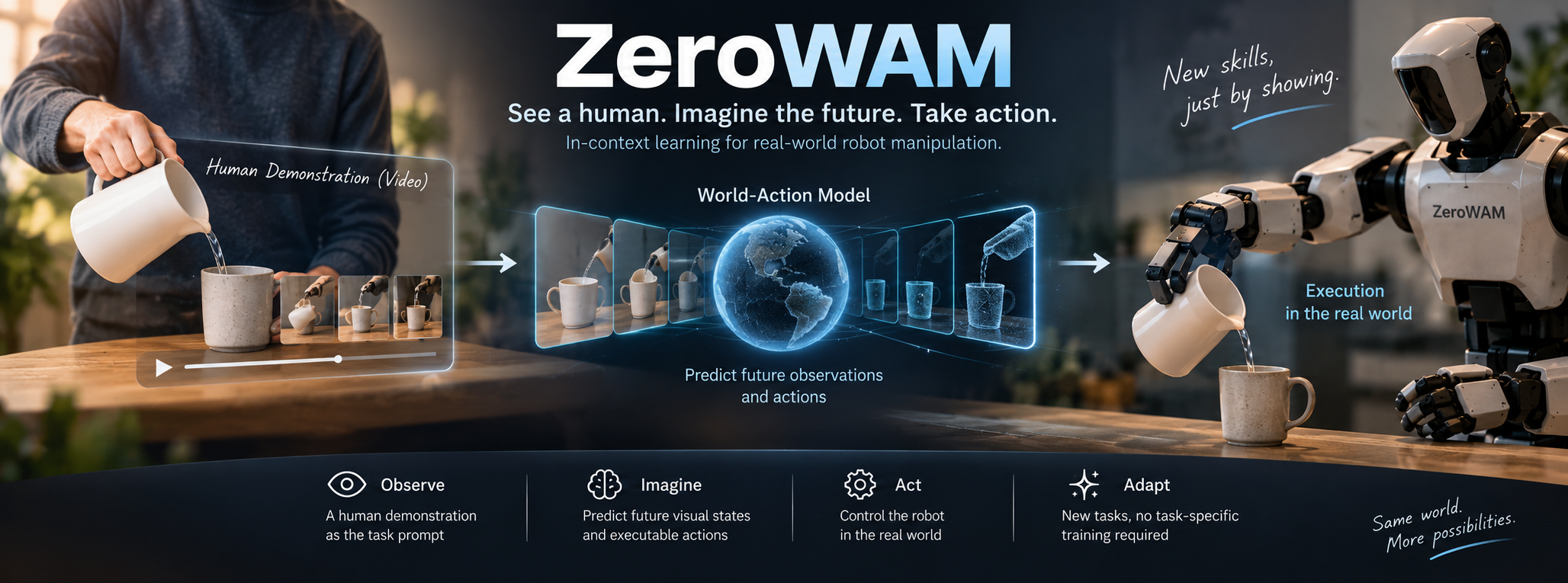
We took a close look at Zero-WAM from the @robbyant_brain team.
We like the direction a lot.
Instead of asking a robot to understand a new task purely from language, Zero-WAM lets a human demonstration video become the prompt. The model predicts how the robot's visual world should evolve and decodes executable actions from that predicted future.
This feels much closer to how we naturally teach physical tasks: show, rather than describe.
The results are also strong. Zero-WAM reports 46.95% average success across seven held-out RoboTwin 2.0 tasks, versus 17.45% for LingBot-VA and 10.98% for WAN-Action. Its IFP objective also matters substantially: removing it drops the reported average from 46.95% to 28.55%.
So we think Zero-WAM is an important result.
But we also think the most interesting questions begin after the headline result.
1. We would still treat Zero-WAM as research, not yet as general robotic ICL
The paper talks about open-ended task generalization, but the demonstrated scope is still relatively controlled.
The authors themselves say their experiments focus primarily on stationary tabletop manipulation, and identify dynamic, unstructured environments, mobile manipulation, and substantially longer-horizon tasks as future work.
This matters when interpreting the numbers.
For example, Zero-WAM reaches an impressive 84.87% on placing an empty cup, but only 9% on stacking three blocks. The latter is still better than both reported baselines, which score zero, but it also shows how quickly performance deteriorates as task structure becomes harder.
Our takeaway is therefore not “general robotic ICL is solved.”
It is that video-conditioned robotic ICL is now credible enough to deserve serious investment.
That is already significant.
2. 10.8B parameters feels very large for the execution loop
The released Zero-WAM checkpoints are 10.8B parameters and roughly 35 GB.
We understand why.
The model is not merely predicting an action vector. It inherits a large video-generation backbone and reasons through predicted visual futures.
Still, from the deployment side, we immediately ask:
Do we really want a 10B+ generative model directly inside the robot's action loop?
To be clear, the paper does not report an end-to-end inference-latency or control-frequency benchmark, so we do not think it is fair to claim that Zero-WAM is too slow.
The problem is that we simply do not know.
Success rate alone is not enough for a robotic policy. We would also want latency, control frequency, VRAM requirements, power consumption and recovery behavior.
And this leads to what we think may be the bigger opportunity.
Perhaps Zero-WAM should eventually be viewed less as the final low-level controller and more as an ICL foundation model.
A large model could understand the human demonstration, infer task structure and produce a compact task representation or plan. A smaller embodiment-specific controller could then execute it at high frequency.
That architecture seems more attractive to us than requiring 10B+ parameters for every low-level decision.
3. Zero-WAM is zero-shot across tasks—but not yet universal zero-shot robotics
This is probably the distinction we care about most.
The seven RoboTwin evaluation tasks really are held out. They do not appear as robot demonstrations during training.
So calling the experiment task-level zero-shot is valid.
But before evaluating those seven tasks, Zero-WAM is post-trained on the other 43 RoboTwin tasks.
That post-training uses 64 GPUs for 4,000 steps, while jointly sampling Task-diverse VA, HumanGen and RoboTwin data.
So the model has already studied the same simulator, embodiment/control setup and broader RoboTwin task distribution.
This is different from what we would call universal robotic ICL.
We would describe the result more narrowly as:
zero-shot cross-task generalization inside a studied domain.
The same qualification appears in the real-world experiment.
Zero-WAM does execute held-out real-world configurations without updating its parameters for those specific configurations. But before evaluation, it is adapted using demonstrations from the same three real-world task families, specifically to fit the Franka robot's kinematics.
Again: this is legitimate generalization.
But it is not yet “bring Zero-WAM to a completely unfamiliar robot and environment, show it one human video, and it figures everything out.”
For us, that is the experiment that would really establish LLM-like robotic ICL.
Train the foundation model once. Freeze it. Move to a substantially new environment or embodiment. Provide only the demonstration at deployment.
How much survives?
4. HumanGen is clever, but its economics are still an open question
HumanGen may actually be one of the most interesting parts of the work.
The team avoids manually collecting tens of thousands of aligned human-robot demonstrations by starting from existing robot trajectories and generating corresponding human demonstrations using VLMs, image editing and video generation.
That produces 74.2K human-robot pairs across 8.6K tasks.
Very clever.
But “automatically generated” and “cheap to scale” are not the same thing.
The pipeline can involve Gemini 3.1 Pro or Qwen3.6-Plus for task analysis, Nano Banana 2 or Qwen-Image-2.0 for image transformation, Wan 2.7 or Kling 3.0 for video generation, followed by another VLM quality check.
Meanwhile, Zero-WAM pre-training alone is reported at 15,360 GPU-hours.
What we could not find is equally important: the paper does not provide HumanGen's total generation compute, dollar cost, rejection rate, or cost per accepted pair.
So we would not yet call this economically scalable.
It is data-scalable in quantity.
Whether it is scalable in cost remains unanswered.
There is also a conceptual point here that we think deserves more attention.
HumanGen begins with an existing robot trajectory, converts that trajectory into a synthetic human demonstration, and then pairs the generated video back with the original robot trajectory.
So it does not create fundamentally new physical robot experience.
It creates a new instructional representation of existing robot experience.
That is still extremely valuable—it teaches correspondence between human intent and robot behavior—but it does not eliminate the need to acquire diverse underlying robot interaction data.
Where we think Zero-WAM could become much more important
This is why our overall view of Zero-WAM is positive.
The current model may not yet be the universal ICL robot policy.
But we think it demonstrates something more fundamental:
human demonstrations can become a native prompting interface for robot foundation models.
Language is great for specifying what we want.
Video can often specify how much more naturally: the object, contact pattern, ordering, intermediate state, orientation and motion are all visible.
If that idea scales, robots could eventually learn new behavior the way modern foundation models use examples in context.
Our ideal next step would therefore focus less on making Zero-WAM simply larger, and more on three questions:
Can this ICL capability survive a genuinely new domain or embodiment?
Can the large model hand its understanding to a much smaller real-time execution policy?
And can HumanGen-like data be produced cheaply enough to scale by orders of magnitude?
We would be very interested in how the Zero-WAM team thinks about these points—especially @JunweiLiangCMU and @YinghaoXu1.
Because if those three problems can be solved, we suspect the lasting importance of Zero-WAM will not be the current 10.8B checkpoint.
It will be the idea that showing a robot an example can eventually become as natural as prompting an LLM.